
From Prompt to Prototype: What the AI Sales Badge Reveals About the Future of Hardware Design
When a tool can take a simple concept like an AI Sales Badge and generate parts, wiring, mechanical layout, and build steps, it signals something bigger than novelty. It shows where real-world system design is heading.
 Brian Schaper • April 04, 2026 • 5 min read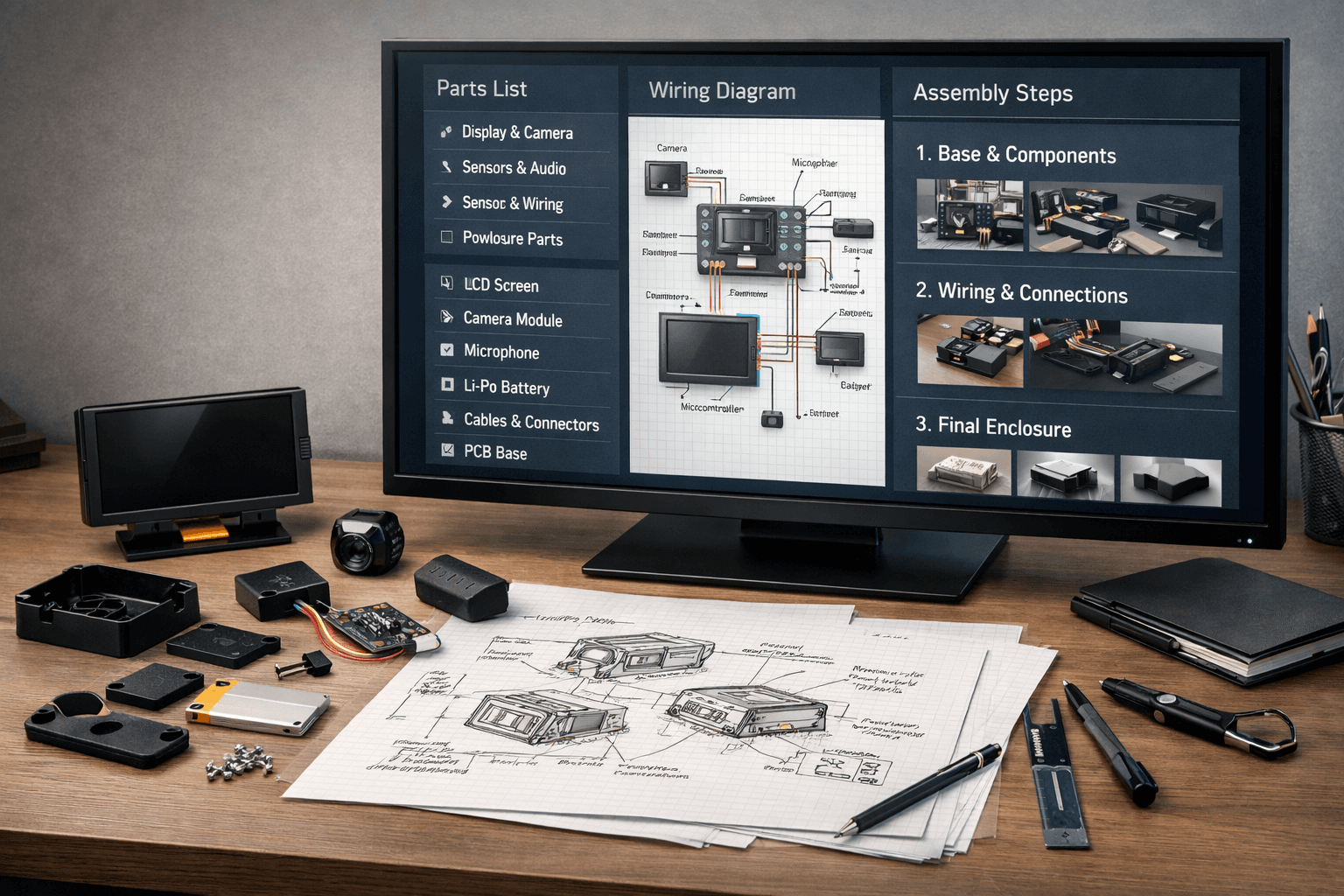
On this page
A lot of people talk about how quickly software can now move from idea to prototype.
That is real.
But what matters even more to me right now is that this pattern is starting to move beyond software and into the physical world.
When I developed the AI Sales Badge concept through Blueprint, what interested me most was not just the device itself. It was the way the system could take a rough product intention and push it into something far more concrete and buildable.
Starting from a simple hardware idea, the system produced:
- a defined concept
- a categorized bill of materials
- electrical components and estimated costs
- mechanical enclosure parts
- wiring and integration planning
- assembly and bring-up instructions
That is not trivial.
It suggests that the interface between idea and hardware is starting to change.
A simple idea, made concrete
The AI Sales Badge concept is straightforward on the surface.
It is a wearable badge with:
- an ESP32 main controller
- an OV2640 face detection camera
- an APDS-9960 gesture sensor
- an INMP441 microphone
- a 2.0-inch ST7789 TFT display
- LiPo battery power
- a charging module and voltage regulation
- a custom 3D-printed enclosure
The purpose of the concept was to explore a wearable device that could analyze customer interactions and present sales-related information directly on the screen. The full estimated build comes in at about $51.50, split across 8 electrical parts and 8 mechanical parts.
That alone is interesting.
But the bigger point is this:
I did not want to stop at a product description. I wanted to see whether a system could take the concept and push it into the kind of structure a builder would actually need to move forward.
That is what made the result worth paying attention to.
Why this matters
For years, one of the hardest parts of hardware has been the translation layer.
You may have a decent idea. You may even know what outcome you want. But moving from that concept into a believable starting architecture usually takes experience, time, and a lot of context switching.
You need to think about:
- compute
- sensors
- display
- power
- charging
- enclosures
- mounting
- wiring
- firmware bring-up
- assembly order
That is where many early ideas stall.
What I found compelling about the AI Sales Badge concept is that it compresses that early-stage design burden into something much more navigable.
Instead of leaving the idea vague, it organizes the work into stages:
- Fabricate
- Wire
- Bring-up
- Assemble
That is a useful shift.
It does not remove engineering. It does not remove testing. It does not remove judgment.
But it does reduce blank-page friction in a meaningful way.
The real signal is not the badge
To me, the badge is not the main story.
The main story is that we are beginning to see systems that can turn intent into structured physical design scaffolding.
That matters because the future will not be software-only.
A lot of the next wave of intelligent products will live at the edge of the physical world:
- wearables
- retail devices
- field service tools
- industrial interfaces
- sensor systems
- robotics components
- operational monitoring devices
In those environments, software is only one layer of the solution.
The physical system matters too.
And if the path from product idea to first prototype gets faster and more structured, more people and more teams can explore ideas that previously would have stayed in notebooks, whiteboards, or backlog documents.
What I like about the output
There is something important about the way this was organized.
What I liked about the AI Sales Badge output is that it did not stop at a flashy rendering or a vague promise. It gave me a practical breakdown:
- named components
- rough unit costs
- quantities
- mechanical print assumptions
- tool requirements
- skill assumptions
- sequencing for build and validation
That is the kind of structure that helps a person reason about feasibility.
Can this be built? Can it be powered reliably? Can it fit in the intended form factor? What skills are assumed? What is still missing? What needs to be swapped before this is truly viable?
Those are the right questions.
This is where these systems get useful. Not because they replace expertise, but because they give expertise something concrete to react to.
Also, this is where judgment still matters
I do think there is an important caution here.
As the person shaping the concept, I am very aware that something like an AI Sales Badge can sound compelling before it has earned its way into the real world. Once you move beyond prototype thinking, the harder questions show up quickly.
For example:
- what data is actually being captured
- how is customer privacy handled
- what does "analyze customer interactions" really mean
- what is processed locally versus elsewhere
- how accurate is the inference
- what is the real battery life
- how rugged is the enclosure
- how wearable is a 70 mm x 100 mm x 36 mm device in practice
That does not make the concept less interesting.
It just reminds me that generated structure is a starting point, not a finished product.
That is exactly how I think it should be viewed.
Why this is relevant to CloudRaven Labs
At CloudRaven Labs, I care a lot about systems that help people move from rough intent to something structured enough to evaluate, refine, and execute.
Sometimes that looks like market research systems. Sometimes it looks like channel intelligence and partner activation. Sometimes it looks like turning scattered business inputs into clearer decision paths.
And sometimes, increasingly, it looks like the same design pattern applied to the physical world.
That is what I was exploring with this project.
The interesting move is not just "AI on a badge."
The interesting move is that I could start with a loosely defined idea and quickly turn it into a more complete planning artifact across electrical, mechanical, and assembly domains.
That is a meaningful shift in interface design.
Final thought
The most important systems in the next few years may not be the ones that generate the flashiest outputs.
They may be the ones that generate the most usable structure.
The AI Sales Badge is a good example of that.
Not because it proves everything is solved. Not because the design is production-ready. But because, from my perspective as the project lead, it shows where things are going:
from concept to components to constraints to sequence to prototype
with much less friction than before.
That is worth paying attention to.
© 2026 CloudRaven Labs. All rights reserved.
Start a conversation with CloudRaven
If this article maps to a workflow, product idea, or GTM problem you are actively working through, CloudRaven can help scope the next move.