
Raising Intelligent Lobsters, Building Good Workflows
OpenClaw shows agents moving closer to where work happens. CloudRaven's Agent Workflow Starter Kit helps teams decide what to delegate, where to set boundaries, and how to keep humans in the loop.
 Rob Schaper • May 02, 2026 • 16 min read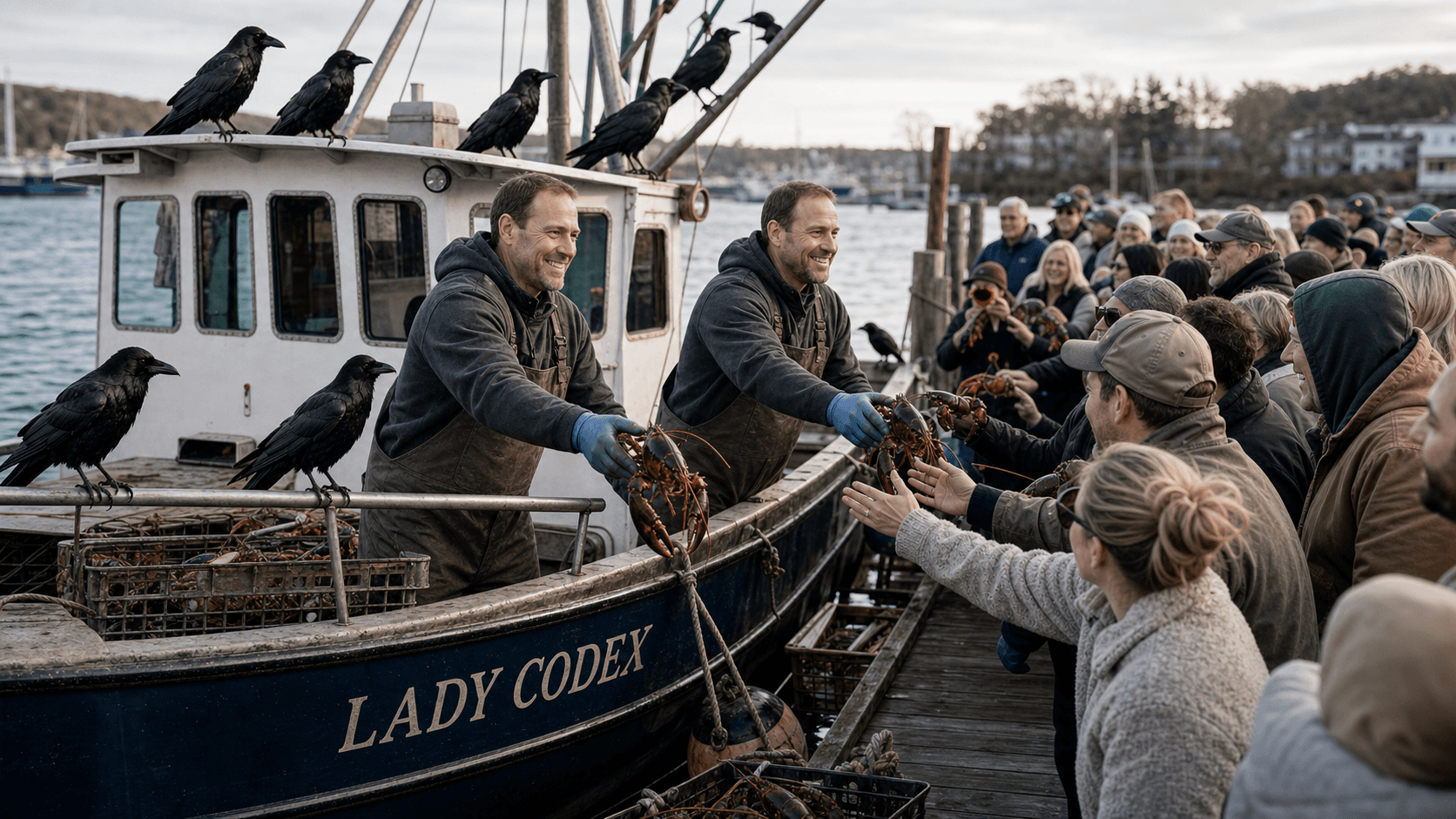
On this page
- For the uninitiated: lets go deeper, what is OpenClaw again?
- What exactly changed
- The important shift: from prompts to workflows
- Why this extends beyond software development
- The mistake most teams will make
- A simple example: the conference badge
- Getting started should not be hard
- Introducing the CloudRaven Agent Workflow Starter Kit
- What your personalized kit will include
- How we are scoping it inside CloudRaven
- The point is not to automate everything
- Where CloudRaven can help
- What leaders should do now
- Why This Week Matters
- Get your personalized Agent Workflow Starter Kit and Onboarding
- References
Our Ravens are now serving OpenClaw. Let the lobstering begin.
Wait. What?
Seafood now?
No.
Before anyone asks: CloudRaven has not pivoted to maritime logistics. There are no lobster tanks in the roadmap, and no melted-butter KPI hiding behind the curtain.
So what is it?
OpenClaw is a viral open-source AI agent project created by Austrian developer Peter Steinberger. Its lobster branding helped spark the Chinese phrase "raising a lobster", shorthand for deploying, training, and running these AI agents for digital work.
This is becoming quite important beacause AI is getting better at understanding intention. The real obstacle for knowledge workers now is turning that intention into controlled, reviewable execution, even more true as longer-term goal-oriented flows come online.
There were some crumbs connecting these dots along several recent AI-agent announcements that can look, at first glance, like a pile of disconnected lobster traps.
Symphony, /goal, OpenClaw login, realtime voice, and the latest Codex improvements are not just about better coding tools, better voice demos, or more convenient agent interfaces.
Taken together, they point to a bigger shift: agents are moving from chat windows into workflow systems and physical devices.
That shift creates urgency for founders, software teams, operations leaders, consultants, sales teams, event organizers, and anyone who is currently responsible for turning messy work into repeatable execution.
The "aha" for many of us in the thick of it is this: the next wave of agent adoption will not be won by the teams that prompt the most. Token maxxxxxxers are OUT. It will be won by the teams that know how to turn intent into bounded workflows with context, tools, permissions, review points, and measurable outcomes.
This trend is important to consider, because essentially, a new role is forming around workflow engineering and observation of different kinds of knowledge work that can hyper-scale. The valuable skill will not be prompting alone. It will be designing the boundary, observing the run, and improving the workflow at the edges.
That is why CloudRaven built the Agent Workflow Starter Kit.
Give everyone some guardrails to get started.
For the uninitiated: lets go deeper, what is OpenClaw again?
OpenClaw is not a lobster.
OpenClaw's own documentation describes it as a self-hosted gateway that connects chat apps and channel surfaces to AI agents. It can run on a user's machine or server, route messages from tools like WhatsApp, Slack, Telegram, Discord, iMessage, and Microsoft Teams, and maintain sessions for an always-available assistant.
The project credits Peter Steinberger as creator. TechCrunch reported that OpenClaw was previously known as Clawdbot and then Moltbot, and that it became known for software agents that can handle practical tasks such as managing calendars, booking flights, or participating in agent-to-agent social spaces.
Steinberger announced on February 14, 2026 that he was joining OpenAI and that OpenClaw would move to a foundation and stay open and independent. Reuters coverage carried by MarketScreener described OpenClaw as an open-source framework for agents that can perform complex tasks with less human input than chatbots, and reported that Baidu, Tencent, and Alibaba were rolling out OpenClaw-based products in China.
So, yeah, "lobster farming" language comes from that adoption wave. Boring. Sorry. Reuters described Chinese users as "raising lobsters" when they run and train OpenClaw agents, while Malay Mail's Reuters-based coverage reported people lining up near a lobster-shaped balloon outside Baidu offices to install it.
Yet today, most AI tools still feel like destinations. You open a tab, type into a box, wait for an answer, and carry the answer somewhere else. OpenClaw-style agents move closer to the messages, devices, software, sessions, background tasks, and follow-up steps where work already happens.
The shift now, is the operating model becomes the main issue: what the agent can access, which tasks it can attempt, how it stores context, how it wakes up, what it is allowed to change, and when a human reviews the result.
What exactly changed
A few announcements stood out because they remove obstacles between intention and execution:
OpenClaw login with a ChatGPT account lowers the access barrier. Sam Altman put the adoption point plainly on X: "You can use your ChatGPT subscription for OpenClaw now." OpenAI's Codex help docs describe the same broader direction: Codex can be connected through a ChatGPT account, and Codex is included with ChatGPT Plus, Pro, Business, and Enterprise/Edu plans. OpenClaw Launch describes the practical OpenClaw path as browser-confirmed OAuth, no API key to paste, and no separate provider account.
Anyone with a tech support background knows this too well. The first obstacle is not imagination. It is simple things like basic user setup. If a user needs API tokens, billing setup, command-line confidence, and developer know-how before the agent can run, the audience stays small. Subscription-backed login moves agents closer to normal product adoption.
Symphony gives agent work an operating model. OpenAI released it as an open-source specification for Codex orchestration, turning issue trackers into always-on agent systems where project work can be assigned to isolated implementation runs instead of being supervised one prompt at a time.
The obstacle is no longer only model quality. It is human attention. Teams cannot scale agent work if every task requires a person to keep multiple sessions alive, remember which agent is doing what, and manually recover stalled work. That is not orchestration. That is operational babysitting.
The Symphony spec describes patterns like per-issue workspaces, repo-managed workflow policy, and observability for multiple concurrent agent runs. In plain English: each task can get its own controlled workspace, its own instructions, and its own review path.
The Codex agent loop makes agent behavior easier to understand. It shows the agent as a loop of reasoning, tool use, inspection, planning, and revision. Teams need to design the environment around the loop, not just ask for better answers.
Harness engineering gives teams a way to think about the system around the model: tools, tests, instructions, repository structure, and review. The short version from OpenAI's post is useful: "Humans steer. Agents execute." The agent is only as useful as the harness it runs inside.
The Codex App Server points toward a more durable execution surface. It is the layer that lets an agent reason, use tools, inspect results, update its plan, and produce useful software changes. An agent's work needs a place to run, not just a box to type into.
OpenAI's Realtime API update changes the trigger surface. Realtime voice makes it easier for a person to express intent naturally, while new capabilities like MCP server support, image input, and SIP phone calling make voice agents more connected to tools and context.
Voice is not only a nicer interface. It is a new way for work to enter the system. But the important question is still what happens after the sentence. A useful voice agent needs workflow state, permissions, escalation rules, and a reviewable output. Otherwise you have a very smooth conversation and no idea what came back in the trap.
The launch of /goal changes the time horizon. A one-shot prompt asks for an answer. A goal asks an agent to keep working toward an outcome over an extended period. OpenClaw's heartbeat and background-task patterns point in the same direction: agents can wake on a schedule, track detached work, surface completions, and continue from persisted state.
Going further, longer-running agents create a new operational problem. Once an agent can keep going and going and going and going, the system needs to have things like progress tracking, retries, observability, handoffs, cost controls, and clear stopping conditions.
Put all this together, and the story is not "we are getting better chatbots."
It is also not "the lobster has learned to code," tempting as that headline may be.
The story is intention becoming executable.
The hard part is making that execution safe, useful, observable, and repeatable.
The important shift: from prompts to workflows
Most people have experienced AI like this:
- Ask a question.
- Get an answer.
- Copy and paste.
- Repeat.
That is useful, but it puts too much burden on the human. You still have to define the work, move information between systems, remember the context, check the output, and decide what happens next.
The emerging pattern looks different:
- A task enters the system.
- An agent gets assigned.
- The agent works in a constrained environment.
- The system tracks progress.
- The agent produces a result.
- A human reviews or redirects.
- The workflow continues.
That is the real shift.
The model still matters. But the surrounding system drives value too: context, permissions, tools, state, review, observability, fallback paths, human approval, and business-specific workflow rules.
That is where organizations need to pay attention.
Why this extends beyond software development
Symphony is focused on coding agents, but the pattern applies far beyond engineering. The workflow pattern is the guardrail.
Most organizations have repeatable work that gets stuck because humans are constantly moving information between systems.
Sales teams research accounts, write outreach, update CRM notes, and prepare follow-ups.
Operations teams check status across systems, escalate problems, and produce summaries.
Product teams turn feedback into tickets, specs, tests, and release notes.
Event teams manage attendees, sponsors, check-ins, badges, games, rewards, and follow-up.
Customer success teams review account history, prepare meeting briefs, draft action items, and track commitments.
These are not just AI chat problems. They are workflow problems. Chat can describe the work. A workflow has to carry it.
Agents need somewhere to run, some tools to use, some rules to follow, and some humans to review the important moments.
The mistake most teams will make
A lot of teams will start by asking, "How do we use agents?"
That question is too broad.
A better question is: "Which repeatable workflow do we understand well enough to safely delegate part of it?"
That is the difference between useful automation and chaos. Chaos is cheaper to start and much more expensive to explain later.
You do not want a vague agent with broad access and unclear goals. That is how you get a confident assistant, a vague mandate, and a Monday morning incident review. You want:
- a specific workflow
- a clear trigger
- known inputs
- allowed tools
- disallowed actions
- a reviewable output
- a human approval point
- a log of what happened
- a way to improve the workflow over time
Agents are more useful when they are constrained.
A simple example: the conference badge
One example I like is a gamified conference badge. No seafood required.
Imagine attendees scanning each other's badges to fill out a bingo card in a mobile app. Complete the bingo card, enter a drawing, and stop by a sponsor booth for a T-shirt.
That is already useful as an engagement loop.
Now add a controlled agent workflow.
When one attendee scans another attendee's badge, the system can check whether the scan is valid, update the bingo card, recommend a conversation starter, identify shared professional interests, and route the attendee toward a relevant booth or session.
The badge and a local Raspberry Pi gateway can handle lightweight local interactions. AWS IoT can capture device events. Step Functions can orchestrate validation, prize eligibility, AI recommendations, booth notifications, and analytics.
The attendee gets a better networking experience.
The sponsor gets measurable engagement.
The event organizer gets a more interesting conference.
The point is not the badge itself. The point is that a real-world action can trigger a controlled workflow. The system behind it does the work.
That is where agents start to become practical.
Getting started should not be hard
Most people do not need to start with a massive agent platform. They need one specific workflow, clear boundaries, and a review point before anything meaningful gets released.
That sounds simple, but it is where most agent experiments get stuck. The intent is usually clear enough: save time, reduce manual coordination, improve follow-up, accelerate implementation, or make a live experience more useful. The obstacle is the operating model.
What exactly starts the work?
What context is trusted?
What should the agent be allowed to touch?
What output is good enough for review?
Where does the human stay in control?
That is the gap the CloudRaven Agent Workflow Starter Kit is designed to close.
They need a way to answer:
- What workflow should I start with?
- What should the agent be allowed to do?
- What should it never do?
- Where should humans stay in the loop?
- What tools do I need?
- What does a good result look like?
- How do I evaluate the output?
- How do I move from prototype to production?
Introducing the CloudRaven Agent Workflow Starter Kit
The CloudRaven Agent Workflow Starter Kit is designed to help people move from "I use ChatGPT sometimes" to "I know the first workflow I should safely delegate."
The goal is simple: help you identify one real workflow, document it, constrain it, prototype it, and decide what to do next.
Instead of downloading a generic PDF, you will be able to create an account, answer a few questions about your role, business, tools, goals, and workflow ideas, and generate a customized Agent Workflow Starter Kit.
Your kit will include guidance specific to your use case, including how to think about tools like Codex, local agents, Symphony-style orchestration, longer-running goals, and realtime voice interfaces.
The point is to connect the announcement-level ideas to a practical first move:
- ChatGPT-backed OpenClaw login shows how agents become accessible without API-key setup.
- Symphony shows how work can be assigned and observed.
- Codex and harness engineering show how agents can execute inside a prepared environment.
- Realtime voice shows how intent can enter the system naturally.
/goalshows why state, retries, and review cannot be afterthoughts.
The starter kit turns those ideas into a first workflow candidate, a boundary, and a prototype path.
The output will not be "here is a chatbot idea." It will be a practical workflow plan with a clear trigger, a controlled path, and a human review point.
What your personalized kit will include
The personalized starter kit will help you define:
- your best first workflow candidate
- the trigger that starts the workflow
- the information the agent needs
- the tools it can use
- the actions it cannot take
- the human review points
- the expected output
- the risk level
- the prototype architecture
- the next steps for implementation
For software teams, the kit may focus on repo documentation, issue triage, QA testing, Codex workflows, or Symphony-style orchestration.
For go-to-market teams, it may focus on account research, partner activation, outreach preparation, lead enrichment, or CRM workflow support.
For event teams, it may focus on badge scans, QR interactions, booth activation, sponsor analytics, rewards, and attendee recommendations.
For operations teams, it may focus on recurring reports, status checks, routing, approvals, and escalation workflows.
For teams experimenting with voice, it may help identify where realtime voice makes sense and where a normal interface is still better.
How we are scoping it inside CloudRaven
We are not treating the starter kit as a separate toy app. It belongs in the same operating surface where agent work can be scoped, reviewed, and improved.
The practical implementation path is to build it on the CloudRaven product surface that already exists: Next.js App Router for the public and authenticated experience, Cognito-backed accounts, Amplify Gen 2 Data for durable records, Lambda-backed custom mutations for business actions, S3 for generated artifacts, and Step Functions for bounded workflow generation.
That fits the way CloudRaven is already built.
The first version is deliberately narrow:
- Account creation and sign-in through the existing access flow.
- A starter-kit intake inside the workspace experience.
- A durable record for each starter-kit request.
- A generated workflow brief with the user's role, workflow candidate, boundaries, tools, review points, and next steps.
- A human-readable artifact stored as a workspace asset.
- A review state so the kit can stay draft, ready for review, approved, or archived.
The system should not begin by giving an agent broad access to email, CRM, GitHub, or production systems. That is not a starter kit. It should begin by helping the user design the workflow.
Execution comes later, after the boundary is clear.
The point is not to automate everything
The point is to start with one workflow that is useful, bounded, and reviewable.
A good first agent workflow should be boring in the right ways. This is not a criticism.
Boring is what you want when software is touching money, customers, operations, or reputation.
It should have clear inputs. It should produce a clear output. It should not require dangerous permissions. It should be easy for a human to inspect. It should save time without creating new risk.
That is how teams build confidence.
Where CloudRaven can help
The starter kit is meant to be useful on its own, but many teams will want help going further.
That is where CloudRaven Labs can support the next step.
We can help teams turn a personalized starter kit into:
- a workflow map
- an agent boundary document
- a prototype architecture
- an State Machine based workflow
- an IoT event pattern
- a Codex or local-agent setup path
- a repo-ready
AGENTS.mdfile configurator - a human approval model test workflow
- a 30-day pilot plan
- a production-readiness review
The bigger opportunity is learning how to design better systems around agents.
What leaders should do now
Here is my practical advice.
Do not start by asking your team to "go use agents."
Start by choosing one workflow.
Document it.
Define the boundary.
Decide what the agent can and cannot do.
Add a human review point.
Run it in a sandbox.
Evaluate the result.
Improve the workflow.
Then decide whether it deserves more investment.
The companies that win with agents will not be the ones that chase every demo. They will be the ones that learn how to turn messy work into controlled, repeatable, observable workflows.
Why This Week Matters
This week matters because the pieces started to connect around one practical idea: agentic workflows are moving beyond coding and into new kinds of knowledge work.
Intent is becoming easier to express, through text, voice, tickets, issues, files, and goals.
Execution is becoming easier to delegate, through Codex, local agents, harnesses, tools, and longer-running agent sessions.
The obstacle is the layer between intent and execution.
That layer decides which intent becomes work, which context can be trusted, which tools can be used, which actions require review, which outputs are accepted, and how the system learns from failure.
That is the layer most teams have not designed yet.
The CloudRaven Agent Workflow Starter Kit, with an option for supported onboarding, makes that first design step concrete. It helps a person or team choose one real workflow, define the boundary, describe the review model, and identify the prototype architecture before anyone gives an agent dangerous access.
That does not mean handing everything to autonomous systems.
It means building practical systems where people, agents, tools, and workflows work together.
That is the part worth learning now.
Get your personalized Agent Workflow Starter Kit and Onboarding
CloudRaven Labs is building a personalized Agent Workflow Starter Kit and onboarding path for people and teams who want to get started safely and practically.
You will be able to create an account, describe your role and workflow, and generate a tailored starter kit with recommended patterns, tools, boundaries, and next steps.
If you are exploring Codex, local agents, Symphony, realtime voice, IoT, process automation, or agent-enabled business workflows, this is designed to help you move from interest to a first controlled workflow.
The goal is not to hype agents.
The goal is to help you build your first useful workflow.
References
- Sam Altman on OpenClaw and ChatGPT subscription access, X, May 2, 2026.
- OpenAI allows ChatGPT subscriptions to be used universally on the agent platform OpenClaw, PANews, May 2, 2026.
- Using Codex with your ChatGPT plan, OpenAI Help Center.
- OpenClaw 2026.4.10: ChatGPT Subscription Support, OpenClaw Launch, April 10, 2026.
- OpenClaw documentation overview, OpenClaw documentation.
- OpenClaw credits, OpenClaw documentation.
- OpenClaw creator Peter Steinberger joins OpenAI, TechCrunch, February 15, 2026.
- OpenClaw, Peter Steinberger, February 14, 2026.
- Baidu joins China's OpenClaw frenzy with new AI agents, Reuters via MarketScreener, March 25, 2026.
- What are OpenClaw AI lobsters and why is everyone in China talking about them?, Malay Mail, March 19, 2026.
- An open-source spec for Codex orchestration: Symphony, OpenAI, April 27, 2026.
- Unrolling the Codex agent loop, OpenAI, January 23, 2026.
- Harness engineering: leveraging Codex in an agent-first world, OpenAI, February 11, 2026.
- Unlocking the Codex harness: how we built the App Server, OpenAI, February 4, 2026.
- Introducing gpt-realtime and Realtime API updates for production voice agents, OpenAI, August 28, 2025.
- Heartbeat, OpenClaw documentation.
- Background Tasks, OpenClaw documentation.
Start with one controlled agent workflow.
Create a CloudRaven account or start a conversation about the workflow you want to turn into a bounded, reviewable starter kit.